One hundred shares, $3,250 pulled from your settlement balance, and a put that vanished from the positions tab — that is what assignment looks like on a Monday morning. What you do next decides whether the campaign stays measurable: knowing how to calculate cost basis after assignment gives every covered call you sell afterwards a real anchor.
To calculate cost basis after assignment, take the strike price paid for the 100 shares, subtract every net premium the campaign has collected — the assigned put plus any earlier rolls — and account for commissions. The result is the effective purchase price per share: the anchor for covered-call strikes and for break-even.
Step-by-step: from short put to owned shares
The numbers below are small and checkable by hand; swap in your own strike and premiums.
- Step 1 — Record the short put. Sold 1 cash-secured put at the $32.50 strike for $0.90 in premium, with a $0.65 commission — net credit $89.35.
- Step 2 — Record the assignment. The put finished in the money, and the shares arrived at the strike: $3,250 paid for 100 shares. A standard US equity option contract covers 100 shares (OCC).
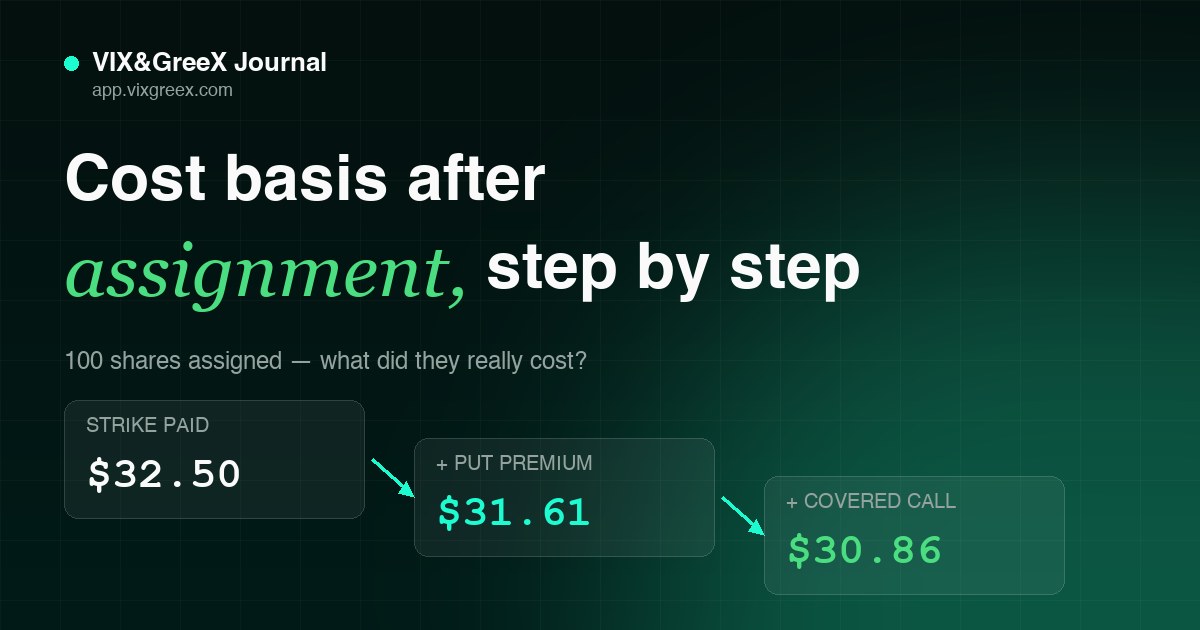
- Step 3 — Do the subtraction. $3,250.00 paid minus $89.35 collected equals $3,160.65 — an adjusted cost basis of $31.61 per share, already almost a dollar under the strike on the day the shares arrive.
- Step 4 — Keep the number running. Selling a $34 covered call for $0.75 (with a $0.65 commission) adds a $74.35 credit: $3,160.65 − $74.35 = $3,086.30, a campaign basis of $30.86 per share.
Exercise and assignment are the same event seen from the two sides of one contract: the holder of the long put exercises it, and a short put seller — selected through the OCC and then by the broker — is assigned and buys the 100 shares at the strike. For the seller the difference is control rather than arithmetic: exercise is a decision you make on an option you own, assignment is something that happens to an option you sold, and the basis calculation above is identical either way.
Adjusted cost basis is what 100 shares effectively cost you after every premium, roll and commission inside the same campaign. A wheel campaign is the full chain of trades on one ticker: cash-secured put → optional rolls → assignment → covered calls. Every later leg keeps editing the same number; nothing resets at assignment. If the put was rolled before the shares arrived, each roll's net credit sits in the same total — that mechanic is worked through in what happens to cost basis when you roll a put.
The tax number is different — on purpose
Adjusted cost basis in this article is a position-management number: what 100 shares effectively cost you after premiums, rolls and commissions in the same campaign. It is not your tax cost basis. The IRS treats each closed option as a separate realized gain or loss, and rules for assignment, buy-backs and wash sales differ. For reporting, use your broker's 1099-B and a tax professional.
One asymmetry catches almost everyone. The premium of the assigned put does reduce the tax basis of the shares — here roughly $32.50 − $0.90 plus fees, about $31.61, close to the management number only because this campaign had no rolls. Covered-call premium, by contrast, does not reduce the shares' tax basis; it is reported as its own option result when the call closes. The mechanics are covered in IRS Publication 550, and the way fees appear on the 1099-B differs by broker.
What to write down on assignment day
Five fields keep the campaign auditable months later: the assignment date; the strike actually paid; the total premium collected before assignment, net of commissions; the resulting adjusted basis per share; and the market price of the stock that day, so the paper gain or loss at arrival is preserved. This record does not replace your broker's statements — it is the management layer on top of them.
Writing the fields down while the fill is fresh takes a minute. Reconstructing them from statements next March takes an afternoon.
Where the campaign math continues
- what happens to cost basis when you roll a put — the full chain before the shares arrive: credit rolls, debit rolls, and what each one does to the break-even.
- does covered call premium reduce cost basis — what happens after the shares arrive, and the exact point where the management number and the tax number stop agreeing.
Where the running number can live
VIX&GreeX Journal is a web app for tracking stock and options trades that links every leg of a wheel campaign — puts, rolls, assignments and covered calls — into one adjusted cost basis. Assignment there is a single entry of about 20 seconds: the shares appear inside the same campaign as the put that produced them, and the basis recalculates on the spot. There is no brokerage connection to configure, because entries are manual — which also means nobody ever gets access to your brokerage account. The trade tracker built for the Wheel keeps one running total per ticker that survives every leg.
FAQ
Is assignment itself a taxable event for the put seller?
Assignment of a cash-secured put is generally not reported as a separate gain or loss. The premium received for the assigned put reduces the tax basis of the purchased shares, and the combined result is realized when the shares are eventually sold. IRS Publication 550 covers the mechanics, and brokers reflect them on the 1099-B.
What cost basis does the broker show after assignment?
Most brokers show the assigned shares at the strike price reduced by the assigned put's premium and adjusted for fees — the tax basis. That figure does not include covered calls sold afterwards or premium from earlier rolls, which is why the management basis in a journal or spreadsheet usually differs from the brokerage statement.
Does a covered call lower the cost basis of assigned shares?
For position management, yes: the covered call's net premium subtracts from the campaign total — in the example above it moves the basis from $31.61 to $30.86 per share. For taxes, no: covered-call premium does not reduce the shares' tax basis. If the call expires or you buy it back, the premium is a separate short-term option result for that year; if the shares are called away, the premium is added to the sale proceeds of the stock rather than reported on its own (IRS Publication 550).
Assignment is the moment the Wheel either stays measurable or dissolves into disconnected rows. Write the number down the day the shares arrive, and every covered call afterwards has an anchor. To have the arithmetic maintained automatically instead, compare the plans — each starts with a 7-day trial.
This article is for educational purposes only and is not financial or tax advice.