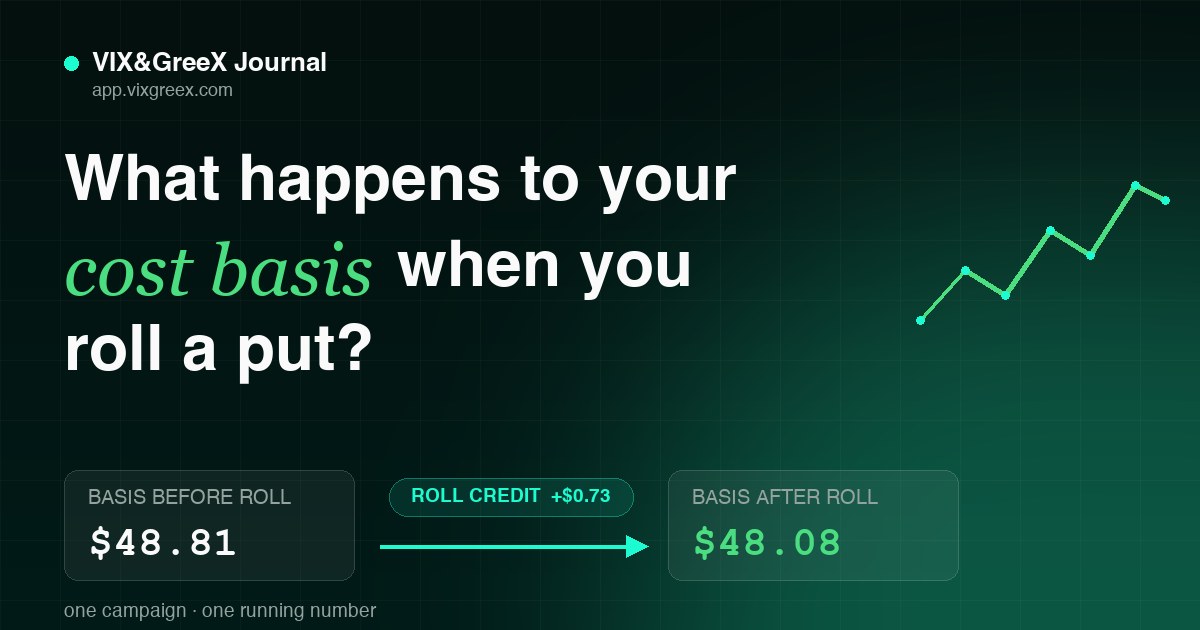
You sold a cash-secured put at the $50 strike, collected $1.20 in premium, and watched the stock slide to $47. You rolled out a month for extra credit, the way the playbook says. Then the statement arrived: a realized loss on the first put, a brand-new position below it, and no obvious answer to what happens to cost basis when you roll a put.
When you roll a put, your effective cost basis moves by the net result of the roll: down by a net credit, up by a net debit. Buying back the old put costs money, selling the new put brings money in, and the difference — minus commissions — joins every other premium in the campaign and sets the price you would effectively pay per share if the new put is assigned.
What a roll actually is
A roll is two transactions at once: buying back the short option and selling another one with a later expiration, a different strike, or both. Most brokers execute it as a single order ticket but book it as two separate trades, and that split is where the confusion starts.
The number that keeps the chain honest is the adjusted cost basis. Adjusted cost basis is what 100 shares effectively cost you after every premium, roll and commission inside the same campaign. As long as every credit and debit lands in one running total, a roll cannot make money disappear — it only moves the total up or down.
The arithmetic is one line: effective basis equals the strike minus all net premium collected across the chain, spread over the shares. A standard US equity option contract covers 100 shares (OCC), so $1.00 of premium moves the basis by $1.00 per share.
A worked example: one put, one roll, one assignment
Small numbers, checkable by hand — swap in your own strikes and premiums.
- Sold 1 cash-secured put, $50 strike, for $1.20 ($1 commission) — net credit $119; basis if assigned: $48.81
- Stock fell to $47; rolled out a month: bought the put back at $3.10, sold the new $50 put at $3.85 ($2 in commissions) — net roll credit $73; total premium collected: $192; basis if assigned: $48.08
- Assigned at expiration: bought 100 shares at $50.00 — cash paid $5,000; adjusted cost basis: $48.08 per share
Cross-check the cash: $5,000 for the shares, plus $310 to close the first put, plus $3 of commissions, minus $505 of premium collected, equals $4,808 for 100 shares — $48.08 each. This example follows the exact sequence a wheel campaign records: sell → roll → assignment → covered call; every covered call sold after assignment keeps subtracting from the same number. If the shares have just landed in your account, the same arithmetic is worked through step by step in how to calculate cost basis after assignment.
What the same roll looks like when it costs you money
Almost every published roll example ends in a credit. Real chains do not. When the stock drops faster than the calendar pays, the put you are buying back has gained more intrinsic value than a new put can cover, and the roll settles as a debit: cash leaves the account, and the running total moves against you.
Take the same $50 put opened for $1.20, and a tape that falls harder than in the first example. Commissions are left out of this second walkthrough so the signs stay visible; at $0.65 per contract, three legs cost about $1.95 in total, or about $0.02 per share.
- Sold 1 cash-secured put, $50.00 strike, for $1.20 — accumulated credit $1.20; break-even $48.80
- Stock at $46.60; bought the put back at $3.40 — $1.20 collected against $3.40 paid, so accumulated credit is −$2.20 until the new leg is sold
- Sold the new put down at the $47.50 strike for $2.60 — net roll debit $0.80; accumulated credit $0.40; break-even $47.10
- Assigned at expiration: bought 100 shares at $47.50 — cash paid $4,750; adjusted cost basis $47.10 per share, or $4,710 for the lot
The roll cost $80 out of pocket and still improved the position — just not by as much as the strike suggests. The strike came down $2.50, from $50.00 to $47.50, while the break-even improved only $1.70, from $48.80 to $47.10. The missing $0.80 is exactly the debit that was paid. Read the strike instead of the break-even and you overstate the repair by $80 on a single lot.
Four rolls in a row: the running ledger
One roll fits in your head. A chain is where the arithmetic quietly goes missing, because each buyback prints as its own loss and no statement column carries the total forward. Below is a different campaign — one put at the $63.00 strike, three rolls, one of them a debit — with the accumulated credit and the break-even restated after every event. One line per transaction, the way a ledger should read.
- Day 0 — sold 1 put, $63.00 strike, for $1.35 — net credit $1.35; accumulated credit $1.35; break-even $61.65
- Day 26 — roll #1, down and out: bought back at $2.05, sold the $62.00 put at $2.60 — net credit $0.55; accumulated credit $1.90; break-even $60.10
- Day 61 — roll #2, down and out for a debit: bought back at $4.10, sold the $59.50 put at $3.35 — net debit $0.75; accumulated credit $1.15; break-even $58.35
- Day 96 — roll #3, same strike, out in time: bought back at $1.85, sold the $59.50 put at $2.40 — net credit $0.55; accumulated credit $1.70; break-even $57.80
- Day 128 — assigned: bought 100 shares at $59.50 — cash paid $5,950; adjusted cost basis $57.80 per share, $5,780 for the lot
Two rows in that ledger are worth more than the total. Roll #2 lost money on the day — $75 paid out — and still improved the break-even by $1.75, because the strike fell $2.50 while the debit was only $0.75. Roll #3 moved no strike at all, so the break-even improved by exactly the credit, $0.55. Whether a roll helped has nothing to do with whether it printed as a credit; it depends on the strike you bought against the cash you paid for it.
The sign rule in one line
Effective basis per share = the final strike minus every credit received, plus every debit paid, plus commissions.
Substitute the debit chain and nothing else is needed: $47.50 − ($1.20 − $3.40 + $2.60) = $47.50 − $0.40 = $47.10 per share.
The mistake that breaks most spreadsheets is treating a debit as its own line — a loss parked outside the premium column — instead of a negative credit inside it. A debit is not a separate event; it is the same running total moving the other way. And when accumulated credit turns negative, the break-even sits above the strike. That is not a formula error: a campaign really can pay out more to stay alive than it ever collected.
Your management number is not your tax number
Adjusted cost basis in this article is a position-management number: what 100 shares effectively cost you after premiums, rolls and commissions in the same campaign. It is not your tax cost basis. The IRS treats each closed option as a separate realized gain or loss, and rules for assignment, buy-backs and wash sales differ. For reporting, use your broker's 1099-B and a tax professional.
Two details deserve precision. The premium of a put that ends in assignment does reduce the tax basis of the purchased shares. A roll, by contrast, is a closed position followed by a new one: the $192 loss on the first put above is a realized result for tax purposes, and when a nearly identical position replaces a losing one within 30 days, the wash-sale rules described in IRS Publication 550 can come into play. The two numbers separate again once the shares arrive and covered-call premium starts landing, which is worked through in does covered call premium reduce cost basis.
Why the broker shows the roll as a loss
Brokerage statements account position by position, because tax reporting requires exactly that. The first put in the example closed for a $192 loss including commissions, and that line is accurate — for that put. What the statement cannot show is that the $384 of fresh credit from the replacement put belongs to the same campaign. (The two $192 figures in this article are a coincidence of the example: one is the loss on the closed leg, the other the premium collected across the whole chain.)
A spreadsheet can hold the chain together, and plenty of Wheel traders run exactly that. The cost is rebuilding formulas after every roll — usually 15–20 minutes — and the running basis still lives in whichever cell was edited last.
One number that survives every roll
The alternative is tracking the campaign instead of the legs. VIX&GreeX Journal is a web app for tracking stock and options trades that links every leg of a wheel campaign — puts, rolls, assignments and covered calls — into one adjusted cost basis. A roll's net credit stays inside the campaign instead of being written off as a loss on a closed leg, each leg takes about 20 seconds to enter by hand, and because this options tracking software has no brokerage connection, nobody ever gets access to your brokerage account.
FAQ
Does rolling a put reset your cost basis?
Rolling a put does not reset the running total — rolling adjusts it. The net credit of the roll (new premium received, minus the buyback cost, minus commissions) is added to the campaign's collected premium, so the effective basis if assigned moves lower after a credit roll and higher after a debit roll.
Is a roll one trade or two?
A roll is entered as one order ticket at most brokers but settles as two trades: closing the existing short put and opening a new short put. Statements therefore show a realized gain or loss on the closed put plus a separate new position, even though the trader treats the pair as one decision.
Does a debit roll raise your cost basis?
A debit roll moves the running total the wrong way: the cash paid subtracts from accumulated premium, so at the same strike the effective basis rises by the debit. It can still improve the break-even when the new strike is lower — paying $0.80 to move from the $50.00 strike down to $47.50 left a break-even of $47.10, against $48.80 before the roll.
Does the roll credit still count if the new put expires worthless?
Yes. If the rolled put expires worthless, the seller keeps every net credit collected across the chain — $192 on a $5,000 commitment in the example above. No shares are purchased, so no cost basis is created; the campaign simply closes with the accumulated premium as its realized result.
A roll never erases information — statements just scatter it across rows. Keep one running number per campaign, and the question at the top of this article answers itself after every adjustment. If you would rather have that number maintained for you, compare the plans — every one starts with a 7-day trial.
This article is for educational purposes only and is not financial or tax advice.